

DRUG LEGALIZATION SERIES
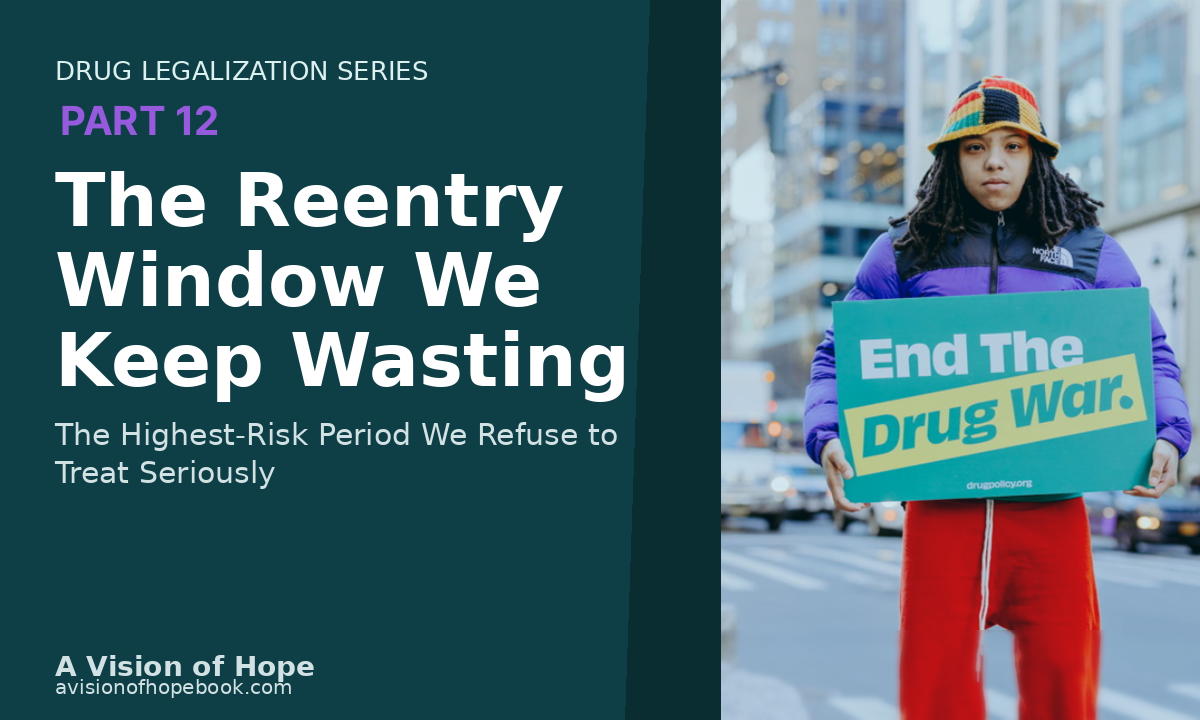
PART 12
If you’re new to the series, start here.
Drug Legalization Series Part Twelve: The Reentry Window We Keep Wasting
The Highest-Risk Period We Refuse to Treat Seriously
If drug policy reform is supposed to reduce harm, then reentry is the credibility test. Adults can argue about freedom, markets, regulation, and enforcement priorities. But the first days after release are where the state either reduces harm or dumps people back into the same drug market with lower tolerance, broken continuity of care, and a much higher chance of death.[1][2][16]
The U.S. still treats release like an administrative event instead of a public safety emergency. That is the mistake. Prison release overdose risk is not a theory problem. It is one of the clearest, most measurable failure points in the entire system.[1][2][16]
This chapter is about prison release overdose risk, prison reentry programs, inmate reentry programs, prison release programs, and medication assisted treatment in jail—what is available before release, what breaks after release, and which models actually reduce overdose, recidivism, and chaos.[3][4][5][6]
Executive Summary
Here’s the core argument in plain language:
-
Prison release overdose risk is heavily concentrated in the first days and first two weeks after release.[1][2][16]
-
Many prison release programs still fail on the basics: medication, naloxone, ID, Medicaid, transportation, housing, and immediate follow-up.[4][10][11][12]
-
In a national survey of 1,028 jails, 43.8 percent offered any MOUD, but only 12.8 percent offered it to anyone with opioid use disorder who requested it.[3]
-
In a 21-state prison study, only 15 percent of prisons provided buprenorphine, 9 percent methadone, 36 percent naltrexone, and 7 percent all three medications.[5]
-
Medication assisted treatment in jail, prerelease Medicaid enrollment, recovery housing, and correctional education all have real outcome data behind them.[6][8][9][12][14][15]
-
If a drug legalization model has no serious reentry plan, it is not a harm-reduction model. It is a slogan.[1][6][13]
Where This Fits in the Series
This Part Twelve is the reentry chapter the series needed. Part 11 covered prevention before use becomes entrenched. Part 10 covered accountability after use is no longer treated as the default crime. Part 9 laid out what regulation would actually look like. Part 7 made the funding case. This chapter closes the loop by dealing with the people the system already touched, punished, and now releases back into the world.[11][13]
If you want the definitions chapter, start here.
And if you want the long-form case for how criminal records keep people stuck after release, Parts 2 and 3 matter too.
Why Reentry Is the Public Safety Test
The sentence does not really end at the gate. It changes form.
Once people leave custody, the risks pile up fast: reduced tolerance, unstable housing, missing documents, interrupted medication, suspended benefits, weak employment prospects, and immediate exposure to an illegal supply that is still contaminated and unpredictable. That is why prison release overdose risk belongs in the middle of any honest drug legalization argument, not in a footnote.[1][2][10][12][16]
The recidivism baseline is ugly too. Bureau of Justice Statistics reports that 62 percent of state prisoners released in 34 states in 2012 were arrested within three years, 71 percent within five years, and 46 percent returned to prison within five years. If those are the default outcomes, then prison reentry programs and inmate reentry programs should be judged on one thing: do they reduce death and reduce churn?[13]
This is also where the tags matter in reality:
-
drug legalization is not credible without reentry
-
naloxone belongs in every opioid-related release plan
-
Medicaid reentry is continuity of care, not paperwork theater
-
recovery housing is a public safety tool
-
correctional education is a public safety tool
-
recidivism is an outcome to reduce, not a label to recycle[4][6][8][9][12][14]
The First Two Weeks: Why Prison Release Overdose Risk Explodes
This is the part nobody should be allowed to hand-wave away.
In Washington State, the first two weeks after release carried a death risk 12.7 times that of other state residents, and the relative risk of death from drug overdose was 129 times higher.[1] In Oregon, the opioid overdose rate after prison release was highest in the first two weeks, at 2,286.7 per 100,000 person-years.[2] In Minnesota, overdose death rates were 15.5 times the general population for people released from jail and 28.3 times the general population for people released from prison.[16]
That is prison release overdose risk in plain English: the state releases people during the exact window when they are most biologically vulnerable.
This is why prison release programs that wait until discharge day are already too late. It is also why medication assisted treatment in jail matters so much. If the person has opioid use disorder, continuity has to begin before release, not after relapse.[2][4][6]
Pre-Release Programming Stats: What Prison Release Programs Actually Offer
This is where the gap between rhetoric and reality gets obvious.
In the national jail survey, 70.1 percent of jails reported some treatment or recovery support. That sounds decent until you get to the part that matters: only 43.8 percent offered any MOUD at all, and only 12.8 percent offered MOUD to anyone with opioid use disorder who requested it.[3] Many prison release programs still use the word treatment while withholding the treatment most linked to lower overdose risk.
The prison side is not much better. Across 21 state prison systems, every system reported that at least one prison offered at least one MOUD, but only 39 percent of the 538 prisons offered any MOUD, and just 7 percent offered all three FDA-approved medications. At the individual prison level, 15 percent offered buprenorphine, 9 percent methadone, and 36 percent naltrexone.[5] Most prison release programs are still not built for broad medication access.
The continuity numbers are weak too. In jails located in counties heavily hit by the opioid crisis, the average availability of measured re-entry services was only 38 percent.[4] In that same study:
-
58 percent helped with Medicaid paperwork before release
-
36 percent could submit Medicaid applications electronically
-
39 percent arranged transportation to a community MOUD provider
-
22 percent provided a bridge supply of multiple doses or days of MOUD
-
18 percent provided written prescriptions
-
50 percent connected people to a peer mentor, navigator, or recovery coach[4]
Naloxone shows the same pattern. In that jail study, 96 percent provided naloxone kits to staff, but only 30 percent provided naloxone kits at release and only 33 percent trained incarcerated people before release.[4] That is not what an overdose-prevention system looks like. That is what a liability-management system looks like.
Basic documents are another failure point. GAO found that about half of people released from federal prison between 2018 and 2021 had at least one ID document in hand. But 37 percent left without any ID, and 11 percent had undetermined ID status in BOP’s data.[10] A lot of inmate reentry programs fail before the first appointment because the person cannot prove who they are.
There is at least one clear area of movement: Medicaid reentry. CMS now allows approved Section 1115 reentry demonstrations to cover certain services for up to 90 days before expected release, and its reentry demonstration page lists a growing group of approved state models. That matters because prison release programs without coverage continuity are setting people up to miss the first month of care.[11]
Post-Release Programming Stats: Which Prison Reentry Programs Actually Improve Outcomes
This is where the evidence gets harder to dodge.
The strongest recent study is the 2025 Massachusetts analysis of 6,400 people with probable opioid use disorder leaving county jails. Of that group, 42.4 percent received MOUD in custody.[6] Those who received medication assisted treatment in jail were far more likely to receive community MOUD within 30 days of release: 60.2 percent versus 17.6 percent.[6] Half were engaged for at least 75 percent of the first 90 days, and 57.5 percent were still receiving MOUD at 180 days.[6]
The outcome differences were not cosmetic. Receipt of medication assisted treatment in jail was associated with lower fatal overdose, lower nonfatal overdose, lower all-cause death, and lower reincarceration after release.[6] That is what real prison reentry programs are supposed to do.
A separate NIH summary of a rural Massachusetts jail study found a 32 percent reduction in probation violations, reincarcerations, or court charges when buprenorphine was offered.[7] Some prison reentry programs work. The ones that work usually look a lot more clinical and a lot less theatrical.
Insurance continuity matters too. In Wisconsin, Medicaid enrollment in the month of release rose from 8 percent at baseline to 36 percent after eligibility expansion and then to 61 percent after prerelease enrollment assistance.[8] In a related study, prerelease assistance was associated with a 7.7 percentage-point increase in any outpatient visit within 30 days after release, along with increases in opioid use disorder visits, any substance use disorder visits, and MOUD receipt.[9] Medicaid reentry is not bureaucracy. It is access.
Housing changes outcomes too. In Washington State, 44 percent of released people with a DSHS service history experienced homelessness within 12 months.[12] Among homeless people leaving prison, those who received housing assistance and exited to permanent housing had better outcomes than those who received none: return to prison was 3 percent versus 9 percent, felony conviction 6 percent versus 15 percent, arrest 35 percent versus 54 percent, and employment 42 percent versus 35 percent.[12] Recovery housing is not a side issue. It is stabilization.
Education and work matter too. RAND’s correctional education meta-analysis found 43 percent lower odds of recidivism for people who participated in correctional education, 13 percent higher odds of postrelease employment overall, and 28 percent higher odds of employment for vocational education participants.[14] If inmate reentry programs ignore work readiness and correctional education, they are ignoring one of the clearest post-release levers we have.
Continuity across the wall matters most. In a randomized trial of a reentry modified therapeutic community for people with co-occurring disorders, reincarceration at 12 months was 19 percent in the reentry model versus 38 percent in the control group, with the best results among those who got treatment in both prison and aftercare.[15] That is the point most inmate reentry programs still miss: pre-release and post-release care have to connect.
What Real Prison Reentry Programs Should Require
If prison reentry programs are supposed to reduce death and disorder, the checklist should be brutally simple.
-
Start the plan before the final week
High-risk releases should not be handled with last-minute paperwork.[11] -
Make medication standard
Medication assisted treatment in jail or prison should be available for continuation and initiation, not reserved for special cases.[3][5][6] -
Turn coverage on before release
Medicaid reentry has to be operational, not aspirational.[8][9][11] -
Put naloxone in people’s hands
Every opioid-involved release should leave with naloxone and training.[4] -
Close the medication gap
Bridge doses, prescriptions, and a scheduled community appointment should be standard parts of prison release programs.[4][6] -
Fix the basics
ID, transportation, and a real contact person are not extras.[4][10] -
Stabilize the landing
Recovery housing, correctional education, and employment linkage belong inside prison release programs, not outside them.[12][14] -
Measure results publicly
Success metrics should include fatal overdose, nonfatal overdose, treatment engagement, housing status, employment, and recidivism at 14, 30, 90, and 180 days.[6][9][12][13]
That is what real prison release programs look like when they are built for outcomes instead of optics.
Where This Belongs Inside Legalization, Regulation, and Accountability
Some people treat reentry as a separate issue from drug legalization. It isn’t.
If we legalize, regulate, or decriminalize parts of the system but still release people into the deadliest days of their reentry window with no medication, no naloxone, no Medicaid reentry, no recovery housing, and no plan, then the reform failed at the most predictable point.[1][4][6][11][12] Prison release overdose risk is where slogans meet measurable reality.
A serious reform model has to do three things at once:
-
regulate supply
-
expand treatment and recovery infrastructure
-
build prison reentry programs and inmate reentry programs that keep people alive long enough to use them
That is not softness. That is competent governance.
If you want to follow the full series as it publishes, visit the blog.
If you prefer audio conversations on recovery, reentry, and purpose, check the podcast page.
And if you want the longer story behind why I write about this, start here.
Frequently Asked Questions
What is prison release overdose risk?
It is the sharply elevated risk of fatal and nonfatal overdose immediately after release from jail or prison, especially in the first days and first two weeks, when tolerance is lower and continuity of care often collapses.[1][2][16]
Do prison reentry programs actually reduce recidivism?
Some do. The strongest evidence is for prison reentry programs that include treatment continuity, housing support, correctional education, and structured aftercare rather than generic discharge paperwork.[6][7][12][14][15]
Why does medication assisted treatment in jail matter so much?
Because medication assisted treatment in jail is associated with better post-release treatment continuation and lower risks of fatal overdose, nonfatal overdose, all-cause death, and reincarceration.[6][7]
What should prison release programs include before discharge?
At minimum: medication planning, naloxone, Medicaid reentry or other coverage continuity, ID, transportation, a scheduled follow-up appointment, and a housing plan.[4][10][11][12]
Where can someone get help right now?
SAMHSA’s National Helpline is available 24/7 at 1-800-662-HELP, and SAMHSA also points people to treatment and support resources online.[17]
References
[1] Binswanger IA, Stern MF, Deyo RA, et al. Release from Prison — A High Risk of Death for Former Inmates. https://pubmed.ncbi.nlm.nih.gov/17215533/
[2] Hartung DM, McCracken CM, Nguyen T, et al. Fatal and nonfatal opioid overdose risk following release from prison: A retrospective cohort study using linked administrative data. https://pubmed.ncbi.nlm.nih.gov/36821990/
[3] Nowotny KM, Nunn A, Brinkley-Rubinstein L, et al. Factors Associated With the Availability of Medications for Opioid Use Disorder in US Jails. https://jamanetwork.com/journals/jamanetworkopen/fullarticle/2823908
[4] Scott CK, Grella CE, Dennis ML, Carnevale J, LaVallee R. Availability of best practices for opioid use disorder in jails and related training and resource needs: findings from a national interview study of jails in heavily impacted counties in the U.S. https://pmc.ncbi.nlm.nih.gov/articles/PMC9763789/
[5] Scott CK, Dennis ML, Grella CE, Mischel AF, Carnevale J. The impact of the opioid crisis on U.S. state prison systems. https://healthandjusticejournal.biomedcentral.com/articles/10.1186/s40352-021-00143-9
[6] Friedmann PD, et al. Medications for Opioid Use Disorder in County Jails – Outcomes after Release. https://pubmed.ncbi.nlm.nih.gov/40929634/
[7] National Institutes of Health (NIH). Offering buprenorphine medication to people with opioid use disorder in jail may reduce rearrest and reconviction. https://www.nih.gov/news-events/news-releases/offering-buprenorphine-medication-people-opioid-use-disorder-jail-may-reduce-rearrest-reconviction
[8] Burns ME, Cook ST, Brown L, Tyska S, Westergaard RP. Increasing Medicaid enrollment among formerly incarcerated adults. https://pubmed.ncbi.nlm.nih.gov/33565117/
[9] Burns ME, Cook S, Brown LM, Dague L, Tyska S, et al. Association Between Assistance With Medicaid Enrollment and Use of Health Care After Incarceration Among Adults With a History of Substance Use. https://pubmed.ncbi.nlm.nih.gov/34994791/
[10] U.S. Government Accountability Office (GAO). Bureau of Prisons: Opportunities Exist to Better Assist Incarcerated People with Obtaining ID Documents Prior to Release. https://www.gao.gov/products/gao-23-105302
[11] Centers for Medicare & Medicaid Services (CMS). Reentry Section 1115 Demonstrations. https://www.medicaid.gov/medicaid/section-1115-demonstrations/reentry-section-1115-demonstrations
[12] Washington State Department of Social and Health Services (DSHS). Achieving Successful Community Re-Entry upon Release from Prison. https://www.dshs.wa.gov/ffa/rda/research-reports/achieving-successful-community-re-entry-upon-release-prison
[13] Bureau of Justice Statistics (BJS). Recidivism of Prisoners Released in 34 States in 2012: A 5-Year Follow-Up Period (2012–2017). https://bjs.ojp.gov/library/publications/recidivism-prisoners-released-34-states-2012-5-year-follow-period-2012-2017
[14] Davis LM, Bozick R, Steele JL, Saunders J, Miles JNV. Evaluating the Effectiveness of Correctional Education: A Meta-Analysis of Programs That Provide Education to Incarcerated Adults. https://www.ojp.gov/library/publications/evaluating-effectiveness-correctional-education-meta-analysis-programs-provide
[15] Sacks S, Chaple M, Sacks JY, McKendrick K, Cleland CM. Randomized trial of a reentry modified therapeutic community for offenders with co-occurring disorders: crime outcomes. https://pubmed.ncbi.nlm.nih.gov/21943810/
[16] Hill K, Bodurtha PJ, Winkelman TNA, Howell BA. Postrelease Risk of Overdose and All-Cause Death Among Persons Released From Jail or Prison: Minnesota, March 2020-December 2021. https://pubmed.ncbi.nlm.nih.gov/39024534/
[17] Substance Abuse and Mental Health Services Administration (SAMHSA). Helplines / Find Substance Use Disorder Treatment. https://www.samhsa.gov/find-help/helplines/
https://www.samhsa.gov/substance-use/treatment/find-treatment