
DRUG LEGALIZATION SERIES
PART 1.5
If you’re new to the series, start here.
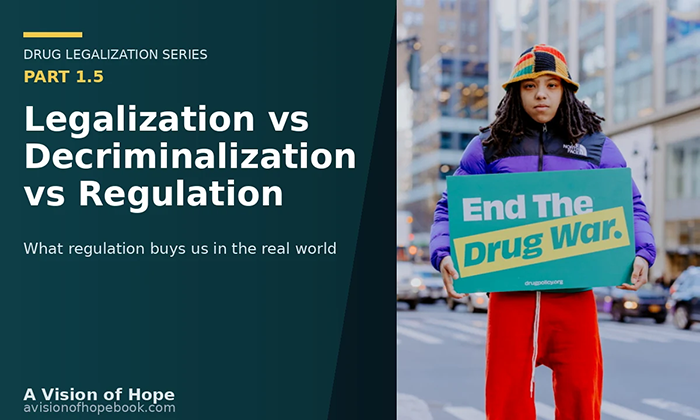
Drug Legalization vs Decriminalization vs Regulation: What I Mean
People talk past each other in this debate because we use one word—“legalization”—to describe three different policies.
So I’m going to be precise.
Decriminalization
Possession/use is no longer a criminal offense (or is handled with civil penalties). The supply chain may still be illegal.
Legalization
A legal pathway to access exists under defined conditions.
Regulation
Rules that govern safety and accountability: licensing, testing, labeling, age restrictions, marketing limits, inspections, penalties, recalls, and data-driven oversight.
What I’m arguing for is legalization with strict regulation, designed around one goal: fewer deaths and fewer adverse outcomes.
Why regulation matters: the safety levers prohibition can’t create
1) Purity, dosage, labeling: stop selling mystery products
A huge driver of overdose is uncertainty: unknown potency, adulterants, contamination, counterfeit pills.
DEA has warned that fentanyl-laced counterfeit pills are increasingly lethal. In 2022 testing, the DEA found 6 out of 10 fentanyl-laced fake pills contained a potentially lethal dose. [1]
Regulation is how you get:
- batch testing
- standardized labeling/dosing
- contaminant thresholds
- accountability when someone violates standards
Prohibition can’t label an illegal baggie. It can only punish people after harm has happened.
2) Harm reduction is prevention, not permissiveness
If the goal is a smaller number of funerals, harm reduction is a fundamental measure of public safety.
CDC states syringe services programs (SSPs) are associated with reduced HIV and hepatitis C incidence and provide linkage to treatment; CDC also notes SSPs do not increase illegal drug use or crime. [2]
The CDC describes fentanyl test strips as a low-cost harm reduction tool that can help prevent overdoses when used with other strategies. [3]
Keeping people alive isn’t endorsement. It’s triage.
3) Supervised consumption sites: reduce death, increase connection to care
This is not “letting people do drugs.” It’s preventing solitary deaths and creating contact with health systems.
A systematic review in Addiction Science & Clinical Practice concluded supervised injection facilities may reduce overdose morbidity and mortality and improve access to care, while not increasing crime or public nuisance in surrounding communities. [4]
4) Accountability still exists. It just stops being stupid
Using a substance should not be a crime.
Harming others should remain one.
A regulated system tightens accountability by shifting enforcement toward:
- unlicensed production and trafficking outside the system
- fraud and mislabeling
- sales to minors
- impaired driving
- violence and coercion
- civil liability for harm
This is the difference between policing sickness and policing harm.
What “responsible legalization” looks like (not a free-for-all)
A serious regulatory framework includes:
- Licensing across the supply chain
- Mandatory testing for identity/potency/contaminants
- Transparent labeling + dosing standards
- Age restrictions
- Marketing restrictions (tobacco-style constraints)
- Track-and-trace (without turning public health into surveillance)
- Pricing/tax strategy that undercuts the black market while funding prevention and care
- Public dashboards that track outcomes, not arrests
And that last point matters: if you don’t measure outcomes, you’re not governing. You’re performing.
If you want the rest of the series, here’s what’s next
- Part 2: What we would get with legalization: safety standards, accountability, and public‑health leverage
- Part 3: Why the black market is the drug crisis (prohibition increases overdose risk and violence)
- Part 4: Why enforcement can’t keep up (tusi, fentanyl additives, THC analogues, the chemistry arms race)
- Part 5: How regulation can fund recovery infrastructure without raising general taxes
This is a replacement model, not a slogan.
If you want to follow the full series as it publishes, visit the blog.
If you prefer audio conversations on recovery, reentry, and purpose, check the podcast page.
And if you want the longer story behind why I write about this, start here.
FAQ
Is drug legalization the same as decriminalization?
No. Decriminalization changes whether possession or use is treated as a crime. Legalization creates a legal pathway to access. Regulation is the system of rules—testing, labeling, licensing, age limits, inspections, penalties, and accountability—that determines whether legalization actually improves safety.
What does “regulation” mean in drug policy?
Regulation means treating drugs like other high-risk products: setting safety standards, requiring testing and labeling, controlling who can sell and who can buy, limiting marketing, and enforcing consequences for violations. It’s about preventing harm, not reacting after it happens.
Does regulation mean “anything goes”?
No. Regulation is the opposite of permissiveness. It creates clear boundaries by defining what’s allowed, what’s restricted, and what’s punished. Unlicensed production, sales to minors, fraud, impaired driving, and violence remain illegal and enforceable.
What is a “regulated drug supply”?
A regulated supply is one where products are tested for identity and potency, labeled with dosing information, and distributed through licensed channels. It replaces guesswork and contamination with standards and accountability.
How does regulation reduce overdose risk?
A major driver of overdose is uncertainty. Street drugs contain unknown strength, adulterants, and counterfeit pills. Regulation reduces that risk by requiring testing, standardizing doses, and holding sellers responsible for misrepresentation or contamination.
Do harm reduction strategies encourage drug use?
Harm reduction is about keeping people alive and reducing predictable harm while treatment remains available. It does not require approving of drug use. It is more acknowledging reality and prioritizing outcomes over moral signaling.
Do supervised consumption sites increase crime?
Evidence reviewed in public health literature shows these sites are associated with reduced overdose deaths and increased access to care, without clear evidence of increased crime or public nuisance in surrounding areas.
What should still be illegal under legalization with strict regulation?
Unlicensed production and trafficking, fraud and mislabeling, sales to minors, impaired driving, violence, coercion, and violations of safety standards. Regulation focuses enforcement on harm, not mere use.
References
[1] DEA: “DEA Laboratory Testing Reveals that 6 out of 10 Fentanyl-Laced Fake Prescription Pills Now Contain a Potentially Lethal Dose.” https://www.dea.gov/alert/dea-laboratory-testing-reveals-6-out-10-fentanyl-laced-fake-prescription-pills-now-contain
[2] CDC: “Strengthening Syringe Services Programs (SSPs).” https://www.cdc.gov/hepatitis-syringe-services/php/about/index.html
[3] CDC: “What You Can Do to Test for Fentanyl (Fentanyl test strips).” https://www.cdc.gov/stop-overdose/safety/index.html
[4] Levengood TW, et al. “Supervised Injection Facilities as Harm Reduction.” Addiction Science & Clinical Practice (2021). https://pmc.ncbi.nlm.nih.gov/articles/PMC8541900/