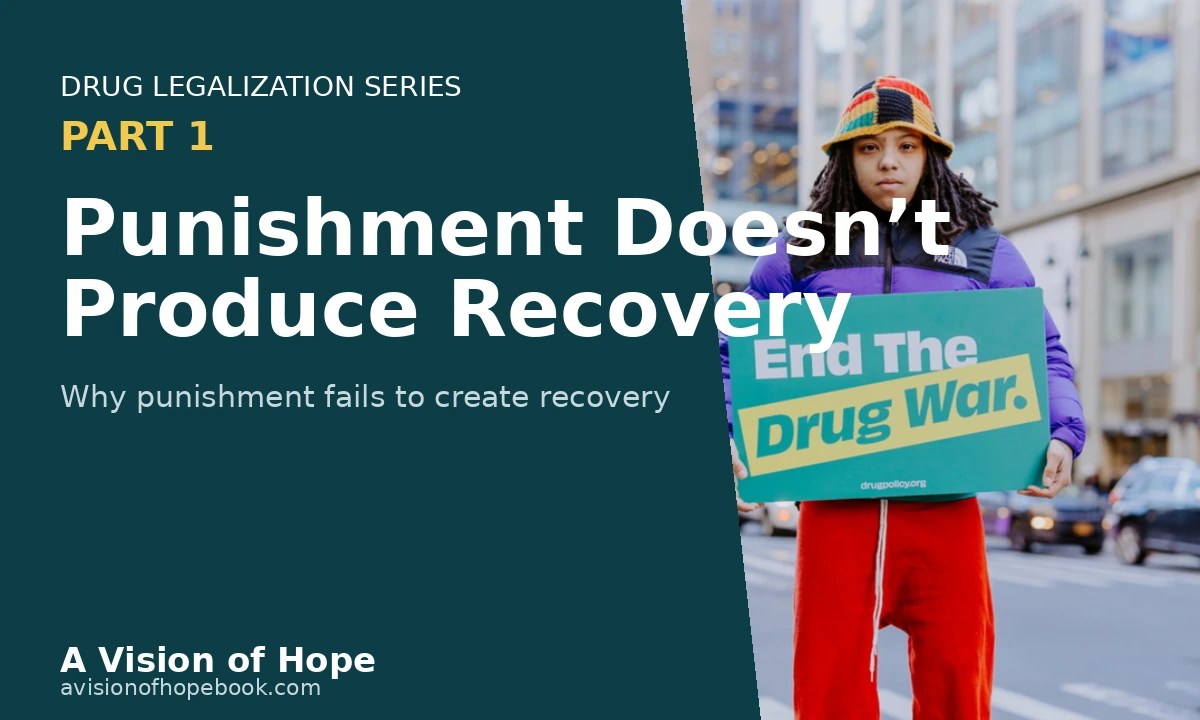

DRUG LEGALIZATION SERIES
PART 1
Drug Legalization Isn’t Endorsement. It’s Harm Reduction — and It’s How We Stop Punishing Pain
I didn’t get sober because I got scared.
I didn’t stop using because the law finally “got tough.” I didn’t turn my life around because a judge threatened me with a longer sentence, or because handcuffs felt humiliating enough to scare me straight.
If fear worked, I would have been free a long time ago.
What the criminalization of addiction gave me was shame. It gave me secrecy. It taught me to hide—my use, my pain, my desperation—because getting honest came with consequences that had nothing to do with healing and everything to do with being branded.
And the part most people miss: once you’ve been branded, the brand follows you. It follows you into job interviews, housing applications, insurance forms, and every background check that quietly decides whether your “second chance” is real or rhetorical.
I’ve watched what happens when people are released from a program or a sentence and are expected to “do better” with less support than they had before they went in. My friend Butch was out of a boot-camp-style prison program for only days before he overdosed and died. The system called that a “choice.” I call it predictable.
Research supports the fact that the post-release window is particularly lethal. In a New England Journal of Medicine study of people released from prison, the risk of death in the first two weeks after release was 12.7 times that of other state residents. [1]
So when I argue for drug legalization and choosing treatment over punishment, I’m doing it from observation and experience—what I watched happen to people I loved, what I watched happen to me, and what I’ve watched happen again and again when the system substituted punishment for care.
If you want the long version of my story, it’s in my book.
The Drug Legalization and Regulation Series (here’s what’s coming)
Next posts:
- Part 1:
Punishment Doesn’t Produce Recovery: Harm Reduction and Why Punishment Fails - Part 1.5 (companion post):
Legalization vs Decriminalization vs Regulation: What regulation buys us in the real world - Part 2:
Criminalization Creates a Permanent Underclass: How drug felonies suppress income, careers, and upward mobility. - Part 3:
Drug Felonies Strip Voting and Gun Rights: How losing civic voice and legal rights keeps people trapped after release. - Part 4:
What Legalization Actually Buys Us: Safety standards and accountability that prohibition cannot deliver. - Part 5:
The Black Market Is the Drug Crisis: How Prohibition Manufactures Overdose Risk, Violence, and Contamination - Part 6:
Chemistry Beats Enforcement: Tusi, Fentanyl Additives, THC Analogues, and Why Enforcement Will Always Be Behind - Part 7:
From Cages to Care: How Regulation Funds Treatment, Recovery, and Reentry Without Raising General Taxes - Part 8:
Fear Is Not a Policy: The Known Failure vs the Imagined Risk - Part 9:
What Regulation Actually Looks Like: A Tiered Model by Risk (Not One Policy for All Drugs) - Part 10:
Accountability Still Exists: What Gets Enforced When Use Isn’t a Crime - Part 11:
Prevention That Isn’t Propaganda: Why Fear-Based Drug Education Fails and What Works Instead - Part 12:
The Reentry Window We Keep Wasting: The Highest-Risk Period We Refuse to Treat Seriously - Part 13:
Mental Health, Housing, and Despair: Why Drugs Aren’t the Root Cause — They’re the Symptom - Part 14:
A More Rational Relationship With Medications: What a Regulated Pharmacy Model Could Look Like for High-Risk Substances - Part 15:
The Hard Objections (Answered Directly): What People Get Right — and Wrong — About Drug Legalization - Part 16:
Pilot, Measure, Scale: How Adult Governments Change Policy Without Betting the Farm - Part 17:
Case Studies Without Cherry-Picking: What Worked, What Failed, and Why - Part 18:
Public Health, Not Moral Panic: Why Drug Policy Keeps Being Written Like a Culture War - Part 19:
This Is Already Being Administered: The Myth That Regulation Is Too Complex to Run - Part 20:
Urgency Without Panic: Why This Can’t Wait Another Decade - Part 21:
Political Reality, Not Political Fantasy: Why This Is More Politically Viable Than Doing Nothing - Part 22:
Public Buy-In Is Built, Not Waited For: How Opinion Actually Changes - Part 23:
What Failure Looks Like If We Don’t Change: Projecting the Status Quo Forward - Part 24:
The Ethical Case for Regulation: Why We Regulate Risky Products (And Why Drugs Shouldn’t Be the Exception) - Part 25:
How to Regulate Synthetics: Fentanyl, Analogues, and the Chemistry Arms Race - Part 26:
Pink Cocaine (Tusi) and Branding: How Marketing Beats Enforcement - Part 27:
Protecting Youth and Families: Age Limits, Marketing Restrictions, and Public Health Guardrails - Part 28:
Set Standards or Keep Burying People: Why the Status Quo Keeps Manufacturing Risk - Part 29:
Regulated Supply: How It Would Work: Licensing, Testing, Labeling, and Enforcement - Part 30:
The Tax Model: Where the Money Should Go, and How to Prevent Corporate Capture - Part 31:
Federal, State, and Local Pathways: How Reform Actually Moves Under Existing Law - Part 32:
How to Talk About This Without Losing the Public: Language, Framing, and Media Traps - Part 33:
The One-Page Case for Regulation: An Executive Summary Policymakers Actually Read - Part 34:
Risk Management, Not Vibes: What “Good Regulation” Requires to Avoid a Vancouver Outcome - Part 35:
International Treaty Constraints: And How Countries Navigate Them - Part 36:
Success Metrics: What to Measure So This Doesn’t Become Another Endless Program
The line policymakers need to see: punishment vs outcomes
Here’s what enforcement did to me (and what it didn’t do):
-
Enforcement did not stop use. It paused it.
-
Incarceration did not treat addiction. It prolonged it.
-
A criminal record did not create stability. It destroyed opportunity.
-
Fear did not build a new life. It kept me trapped in the previous one.
-
Shame did not produce honesty. It produced isolation.
None of that is a moral statement. It’s an outcomes statement.
And outcomes are what public policy is supposed to optimize.
This isn’t just personal — it’s measurable
Even with recent improvements, overdose deaths remain a national emergency. CDC reported overdose deaths fell sharply in 2024 compared with 2023, but the totals are still massive. [2]
We also spend heavily on drug control. The Office of National Drug Control Policy’s FY 2025 budget highlights show $44.5 billion requested for National Drug Control Program agencies. [3]
Now compare that to treatment over punishment economics: NIH notes studies showing that every $1 spent on substance use disorder treatment saves $4 in health care costs and $7 in criminal justice costs. [4]
That’s not a “soft” argument. That’s a fiscal argument for treatment over punishment.
The distinction people keep collapsing
Before we talk drug legalization policy, we have to stop flattening reality.
1) Drug ≠ drug
Fentanyl is not cannabis. Meth is not psilocybin. Alcohol isn’t safer because it’s legal; it’s just familiar.
Different classes, different risks, different responses. When we pretend everything is the same, we write blanket policy for the worst-case scenario and apply it to everyone.
2) Use ≠ addiction
Substance use and substance use disorder are not the same thing, and national reporting tracks them separately. [5]
3) Addiction ≠ moral failure
Addiction is a human problem—often a trauma problem, often a mental health problem, often a despair problem. Turning it into a crime doesn’t make it less real. It makes it more hidden and harm reduction less effective.
Criminalization raises the price of honesty. Recovery requires honesty. That’s a contradiction we’ve normalized for decades.
Drug Legalization isn’t endorsement. It’s control.
Here’s the sentence I wish we could tattoo onto every debate:
Drug legalization is not an endorsement of drug use. It’s a decision to regulate reality instead of surrendering it to the black market.
And yes: crimes committed under the influence or in pursuit of drugs—DUI, violence, theft, trafficking outside the regulated system—should still be punished. What I reject is making use itself a crime.
If you want the policy blueprint and what strict regulation actually looks like, that’s in the companion post: Part 1.5.
Closing
The threat of punishment was never enough to keep me clean.
Lasting change had to be internal. It had to be chosen. And it became possible when I had support, structure, and a path forward—not when I had a boot on my neck. Order and read A Vision of Hope for my whole story.
If you or someone you love is struggling right now, help is available: SAMHSA’s National Helpline is free and confidential, 24/7. [6]
If you want to follow the full series as it publishes, visit the blog.
If you prefer audio conversations on recovery, reentry, and purpose, check the podcast page.
And if you want the longer story behind why I write about this, start here.
Frequently Asked Questions
Find answers to your questions about my books, events, and more.
Does punishment work for addiction?
For many people, punishment may interrupt use temporarily, but it rarely builds the stability recovery requires. If the underlying drivers (trauma, mental health, isolation, housing instability) aren’t addressed, fear tends to produce secrecy, not healing.
Why is the period right after release from jail/prison so dangerous?
Because tolerance often drops during forced abstinence, while real-world supports may be weak or nonexistent. People return to an unpredictable supply with a body that can’t handle what it used to. This is why continuity of care after release matters.
Is drug legalization an endorsement of drug use?
No. It’s a decision to regulate reality instead of outsourcing the supply chain to the black market. Regulation is about standards, safety, accountability, and prevention, not approval. The criminalization of addiction has not produced desired drug policy outcomes, so sensible reform is called for.
What’s the difference between drug use and addiction?
Not everyone who uses a substance has a substance use disorder. Addiction is a clinical condition with impaired control and harmful consequences. Policy should be written for reality, not stereotypes.
What should still be punished in a drug legalization/regulation model?
Actions that harm others: impaired driving, violence, theft/coercion, child endangerment, and trafficking outside the regulated system. The argument isn’t “no consequences.” It’s “stop criminalizing use as the default.”
What should we measure to judge whether policy works?
Not arrest counts. Real outcomes: overdose deaths, treatment engagement and retention, infectious disease rates, reentry mortality, public disorder complaints, and employment/housing stability for people rebuilding their lives.
Where can someone get help right now?
If you or someone you love is struggling, SAMHSA’s National Helpline is free, confidential, and available 24/7: 1‑800‑662‑HELP (4357).
References
[1] Binswanger IA, et al. “Release from prison—A high risk of death for former inmates.” N Engl J Med. 2007. (12.7x risk in first 2 weeks). https://pubmed.ncbi.nlm.nih.gov/17215533/
[2] CDC NCHS Press Release: “U.S. Overdose Deaths Decrease Almost 27% in 2024.” (May 14, 2025). https://www.cdc.gov/nchs/pressroom/releases/20250514.html
[3] ONDCP: National Drug Control Budget FY 2025 Funding Highlights (PDF). https://bidenwhitehouse.archives.gov/wp-content/uploads/2024/03/FY-2025-Budget-Highlights.pdf
[4] NIH: “Societal Benefits of Improved Health” (includes $1 → $4 healthcare + $7 criminal justice savings). https://www.nih.gov/about-nih/impact-nih-research/serving-society/societal-benefits-improved-health
[5] SAMHSA: “Results from the 2023 National Survey on Drug Use and Health (NSDUH): Annual National Report.” https://www.samhsa.gov/data/sites/default/files/reports/rpt47095/National%20Report/National%20Report/2023-nsduh-annual-national.htm
[6] SAMHSA National Helpline (24/7). https://www.samhsa.gov/find-help/helplines/national-helpline